On October 9th, 2005 I was enjoying the view at First Encounter Beach in Eastham, Massachusetts and watching a small flight of seabirds. A flock of gulls began to gather on the beach close to my car and I found myself more and more engrossed in the plumage variation of Ring-billed Gulls. This first photo shows two first-fall Ring-billed Gulls sleeping, with very different plumage – the one on the left still in full juvenal plumage, while the one on the right has replaced most of the body feathers with first-winter plumage.
Two Ring-billed Gulls of similar age but very different appearance. Eastham, MA, 9 Oct 2005. Photo copyright David Sibley.
This much is familiar to many experienced birders, but on this date I was struck by the fact that these two birds, in two different plumages, are more or less the same age. That is, they were both born in the summer of 2005, but by early October one has advanced into the next generation of feathers, while the other retains all of its juvenile feathers. The difference in appearance is striking, with variation in molt timing combined with variation in juvenal and first-winter plumage colors. Note also the difference in leg color, which seems to parallel variation in bill color.
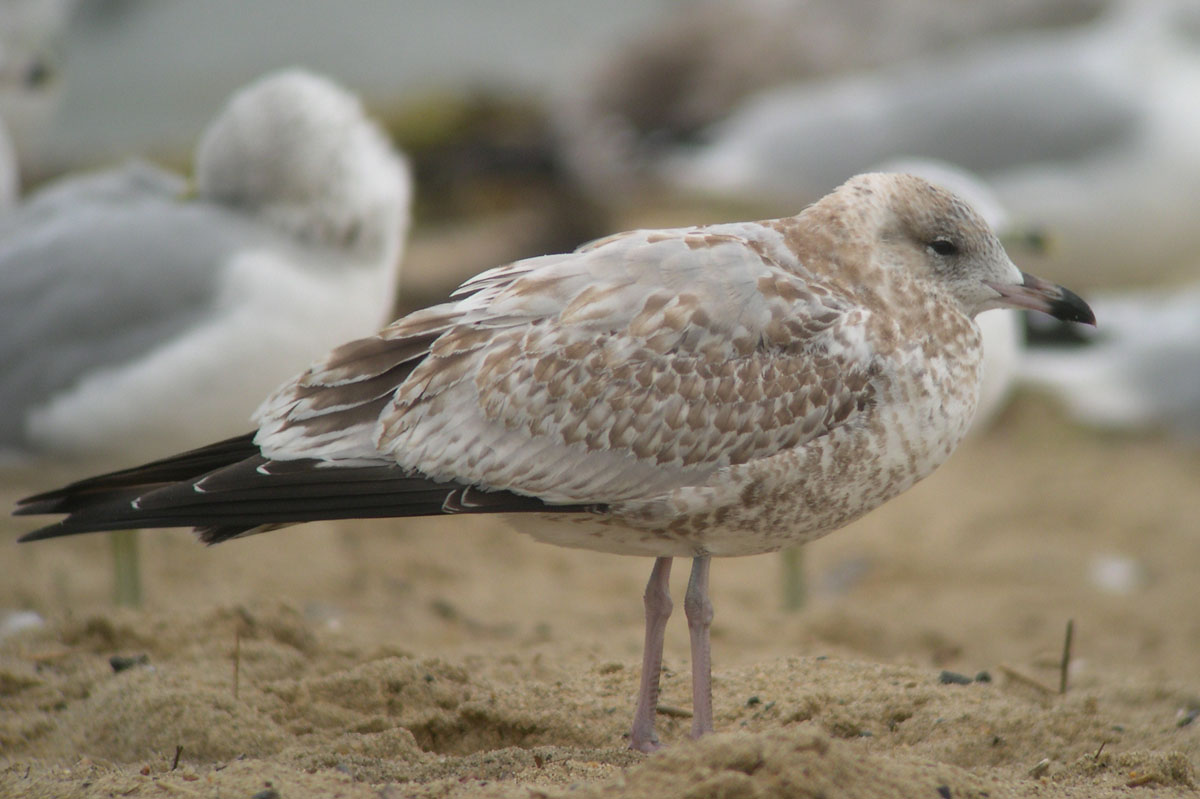
I photographed about 15 immature Ring-billed Gulls that afternoon, and I have arranged the photos here according to plumage: from full juvenal plumage to the most advanced first-winter plumage. The bird on the left appears below in photo number 1, the bird on the right in number 10.
These were digiscoped with a Nikon Coolpix 4300 hand-held to the 30X eyepiece of a Swarovski AT80 HD telescope. The sky was overcast with some light rain, requiring long exposures and accounting for the blurring in some photos.
1) This is a very dark and fresh-looking juvenile, with mostly dark bill, much as one would expect in late summer. Photo copyright David Sibley.2) A different juvenile, nearly as dark as 1. Photo copyright David Sibley.3) Yet another bird still in full juvenal plumage with no replaced 1st winter feathers, but this one is much paler than the first two. The bill has become pink at the base, but not yet with the sharply two-toned pattern of typical first-winter. Photo copyright David Sibley.

4) A very pale and orange-toned juvenile; this bird has replaced a few body feathers with 1st-winter plumage, most conspicuous on the mantle and scapulars, where the new feathers are grayish with bold dark bars. Photo copyright David Sibley.5) This bird is still mainly in juvenal plumage, but has replaced a few scapulars and a few wing coverts with clean gray 1st-winter feathers. Photo copyright David Sibley.6) This bird is nearly identical to (7) below in molt stage, but the retained juvenal feathers are darker and less orange. Photo copyright David Sibley.7) Another with relatively pale and orange-toned juvenal feathers like (4) above, but this one has molted a large patch of scapulars, and the new 1st-winter feathers are relatively clean gray. Photo copyright David Sibley.8) Most mantle and scapulars new and grayish, but the lowest row are brownish and faded juvenal feathers. Photo copyright David Sibley.9) An interesting mixture of new 1st-winter feathers with dark bars (on mantle, breast, and flanks), contrasting with retained juvenal feathers with pale orange-brown bars (on nape, belly, wing coverts, and some scapulars). Photo copyright David Sibley.10) Most scapulars replaced, but some new ones show dusky centers. Photo copyright David Sibley.11) All scapulars and some wing coverts replaced, most with faint dusky bars. Photo copyright David Sibley.12) All juvenal mantle and scapular feathers replaced with pale gray 1st-winter feathers, but all showing a "ghost" of the juvenal color pattern. Photo copyright David Sibley.13) The most advanced-looking plumage seen, with all mantle and scapulars replaced and almost all clean gray (but almost no wing coverts replaced). Note that the bird in photo (11) above is more advanced in molt, with many replaced wing coverts, it just looks "younger" because the new feathers are not as clean gray as (13) here. Photo copyright David Sibley.
Related Posts
6 thoughts on “Variation in immature Ring-billed Gulls”
I have always had trouble identifying the early phases for immature ring billed gulls. Your photographs help immensely in making the identification much easier. Thanks for the info.. Gregory Watkevich
I have always wondered about this topic, with waterfowl and other groups of birds and I think it hs something to do with actual birthdate of the juvie. For example, we can have breeding birds from May through July orAugust, so looking at two birds that may have been born up to 3 months apart will show up by the younger birds not having enough time to go through the process as fully as the older birds.
Just a thought!
It is February 15th, 2014. I just got finished getting a long, close look at a young gull that “should” be a summer-plumaged Ring Bill (I am in Plattsburgh, NY). Very dark tail; mid-tone dark brown flight feathers with pale tips; dark cheeks but lighter nape, neck and crown; slender bill…dark all over with warmer tones near the base; pinkish legs. Can’t figure out what else it could be. Saw it standing next to an adult Ring Bill and it appeared a smidge slight/smaller. Who knows? Any feedback would be greatly appreciated. Please reply to my email with “Gull” in the heading. Thanks!
Paul
The flag defines if the Security Firewall was passed.
Session
spbc_cookies_test
Cookie to test cookies so we know that everything working properly
Session
ct_sfw_
Group of cookies used for our SpamFireWall technology.
Session
ct_
Group of cookies used for storing dynamic variables from browser
Session
apbct_
Group of cookies which are set from backend and contain information about the current user
Session
apbct_cookies_test
Сookie to validate other cookies, so they can’t be spoofed.
Session
ct_timezone
Used in order to detect spam and improve the website's security.
Session
ct_ps_timestamp
Used in order to detect spam and improve the website's security. Does not store visitor specific data.
session
ct_pointer_data
Used in order to detect spam and improve the website's security. Does not store visitor specific data.
session
ct_has_scrolled
This cookie is used to distinguish between humans and bots.
session
ct_fkp_timestamp
Used in order to detect spam and improve the website's security. Does not store visitor specific data.
session
ct_check_js
Used in order to detect spam and improve the website's security.
session
apbct_antibot
This cookie is used to distinguish between humans and bots. This is beneficial for the website, in order to make valid reports on the use of their website.
session
spbc_2fa_passed
Dashboard. Flag defines if Two-Factor Authentication was passed.
Session
spbc_log_id
Dashboard. User identification.
Session
spbc_timer
Dashboard. Time spent on the page.
Session
These cookies are needed for adding comments on this website.
Name
Description
Duration
comment_author_url
Used to track the user across multiple sessions.
Session
comment_author_email
Used to track the user across multiple sessions.
Session
comment_author
Used to track the user across multiple sessions.
Session
Statistics cookies collect information anonymously. This information helps us understand how visitors use our website.
Google Analytics is a powerful tool that tracks and analyzes website traffic for informed marketing decisions.
Used to monitor number of Google Analytics server requests when using Google Tag Manager
1 minute
_gid
ID used to identify users for 24 hours after last activity
24 hours
_ga_
ID used to identify users
2 years
_gali
Used by Google Analytics to determine which links on a page are being clicked
30 seconds
_ga
ID used to identify users
2 years
__utmx
Used to determine whether a user is included in an A / B or Multivariate test.
18 months
__utmv
Contains custom information set by the web developer via the _setCustomVar method in Google Analytics. This cookie is updated every time new data is sent to the Google Analytics server.
2 years after last activity
__utmz
Contains information about the traffic source or campaign that directed user to the website. The cookie is set when the GA.js javascript is loaded and updated when data is sent to the Google Anaytics server
6 months after last activity
__utmc
Used only with old Urchin versions of Google Analytics and not with GA.js. Was used to distinguish between new sessions and visits at the end of a session.
End of session (browser)
__utmb
Used to distinguish new sessions and visits. This cookie is set when the GA.js javascript library is loaded and there is no existing __utmb cookie. The cookie is updated every time data is sent to the Google Analytics server.
30 minutes after last activity
__utmt
Used to monitor number of Google Analytics server requests
10 minutes
__utma
ID used to identify users and sessions
2 years after last activity
_gac_
Contains information related to marketing campaigns of the user. These are shared with Google AdWords / Google Ads when the Google Ads and Google Analytics accounts are linked together.
90 days
Jetpack's built-in visitor analytics. It records page views, referring sites, search terms, and outbound link clicks, and also carries the shared visitor-tracking library used by Jetpack Instant Search and WooCommerce Analytics.




Excellent. Many thanks for a clear, step-by-step lesson in an area which I’ve always found daunting.
I have always had trouble identifying the early phases for immature ring billed gulls. Your photographs help immensely in making the identification much easier. Thanks for the info.. Gregory Watkevich
Thank you for the very helpful information.
I have always wondered about this topic, with waterfowl and other groups of birds and I think it hs something to do with actual birthdate of the juvie. For example, we can have breeding birds from May through July orAugust, so looking at two birds that may have been born up to 3 months apart will show up by the younger birds not having enough time to go through the process as fully as the older birds.
Just a thought!
It is February 15th, 2014. I just got finished getting a long, close look at a young gull that “should” be a summer-plumaged Ring Bill (I am in Plattsburgh, NY). Very dark tail; mid-tone dark brown flight feathers with pale tips; dark cheeks but lighter nape, neck and crown; slender bill…dark all over with warmer tones near the base; pinkish legs. Can’t figure out what else it could be. Saw it standing next to an adult Ring Bill and it appeared a smidge slight/smaller. Who knows? Any feedback would be greatly appreciated. Please reply to my email with “Gull” in the heading. Thanks!
Paul
Thanks for this! Confused observing them in Montreal Canada in late autumn with their variable plumage. Very interesting.