

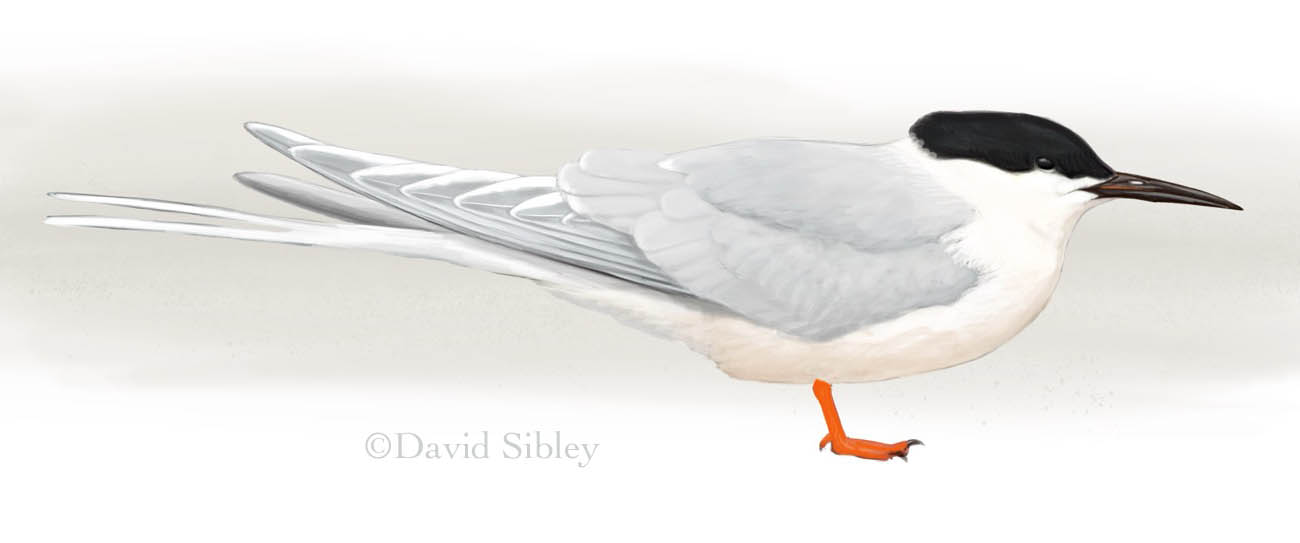
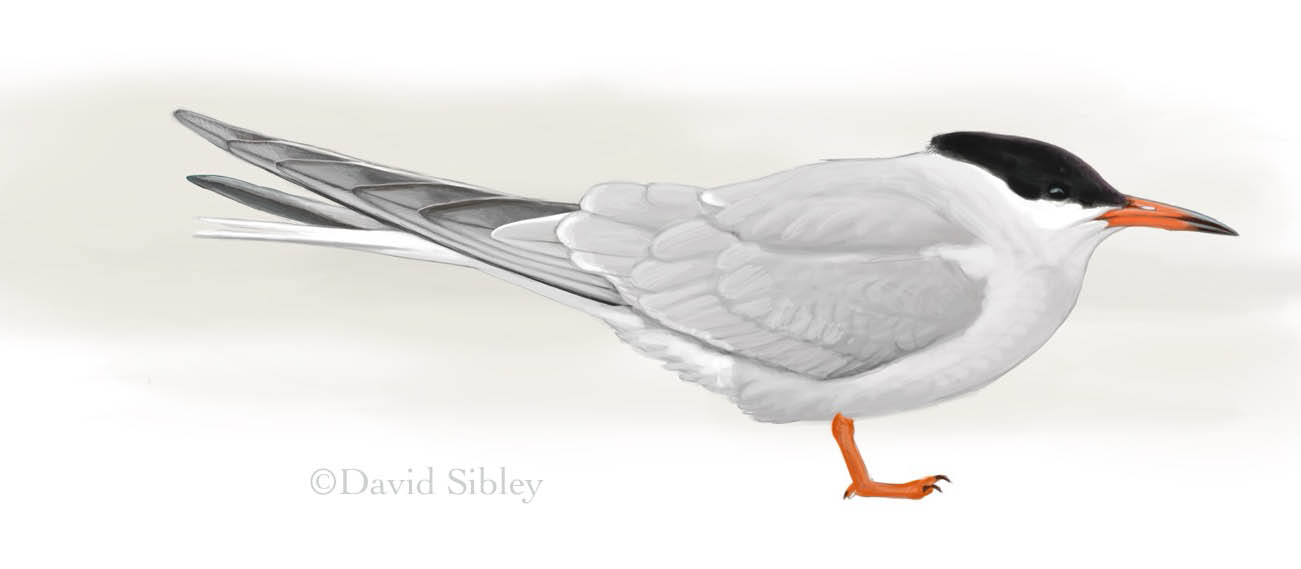
Identifying terns is hard. The differences between species are small and mostly subjective, and each species can look very different depending on age and season. There is one feature, however, that separates perched Roseate Terns from other species with near 100% confidence.
You just need to look at the folded wingtips. When the wing is folded the primaries are stacked into a long narrow point that extends out over the tail. The outer webs of the primaries (the leading edges) are along the lower edge of that point, and the inner webs (the trailing edges of the primaries) form the upper edge of that point.
On Roseate Tern the inner web of each primary has a narrow band of white all the way to the tip. On Common, Arctic, and Forster’s Terns those same feathers are gray from edge to edge. They can range from pale silvery gray with a very narrow white margin (when fresh), to nearly black when worn, and they can show notches of white, but never show the continuous white edge characteristic of Roseate Tern.
As with any other field mark, you shouldn’t rely on this feature alone to identify a Roseate Tern, but it’s a strong clue, and it is the best way to quickly check a flock of resting terns for possible Roseates.
I have always had trouble distinguishing Common Terns from Roseates. Merlin’s first choice for a tern that I photographed today was Roseate Tern. I checked all my references, including your Guide to Birds, first edition; and your Field Guide to Birds of Eastern North America, but the variations in bill and leg color confused me. I finally found your trick that made the identification easy; folded wingtip entirely gray. The tail was also relatively short. Common Tern.
Thank you very much,
Ken Kahn
(still photographing birds, albeit slowly, at 87)
That’s great to hear, I’m glad this was helpful!