

Comparing two subspecies of Brewer’s Sparrow Spizella breweri
- S. b. breweri often called Sagebrush Brewer’s Sparrow
- S. b. taverneri known as Timberline Sparrow
On 22 June 2026 I was heading home from a trip with TNC Montana to their amazing Matador Ranch, and took advantage of my last morning for some birding just outside Billings. One of the species I wanted to spend a little more time with was Brewer’s Sparrow, and I found several, but one of them looked and sounded different. In all details it seemed to match the northern Rocky Mountain subspecies commonly known as Timberline Sparrow. The only hitch is that it was singing and acting territorial in sagebrush habitat about 300 miles southeast of the nearest known breeding site. Here is a link to my ebird list with photos and audio.
Timberline Sparrow was described as a new species Spizella taverneri by Swarth and Brooks (1925) from specimens collected in high elevation alpine habitat in British Columbia. Its status as a full species was never widely accepted, and has been the subject of debate ever since. It remains enigmatic, 100% identifiable in breeding season specimens but nearly 100% ambiguous in the field! There are still almost no records away from the breeding grounds, which reach from Alaska south to northwestern Montana.
Brewer’s Sparrows found breeding in treeline habitat at high elevation in Colorado and elsewhere were the subject of long-running debate. Some birders identified them as Timberline based on their alpine habitat and perceived differences in appearance, but they were well south of the known range of Timberline. A detailed study by Walker at al (2024) clarified that, although alpine birds in Colorado show some tendencies towards Timberline in plumage, most features overlapped with or were closer to Sagebrush Brewer’s, and Colorado alpine and sagebrush birds were genetically indistinguishable.
I am confident that the bird I saw in Billings matches the appearance of Timberline Sparrow, or at least is closer to that than to Sagebrush Brewer’s, but it raises a lot of questions. This would be the first summer record away from alpine habitat. Is it really an out-of-place Timberline, or is it an intergrade, or can the extreme of variation in the Sagebrush population match this? If it is Timberline, is it a late migrant or “floater”? And have birds like this been occurring in this habitat and just gone unnoticed? And the fundamental question of species status – if it is a Timberline, will it be able to attract a Sagebrush Brewer’s as a mate?
I am presenting these illustrations and a summary of what I’ve learned about distinguishing the two subspecies in summer, hoping that it will be useful for others to find more potential Timberline Sparrows, and to get closer to answering some of these questions.
Comparing typical Timberline to Sagebrush Brewer’s Sparrows
Timberline
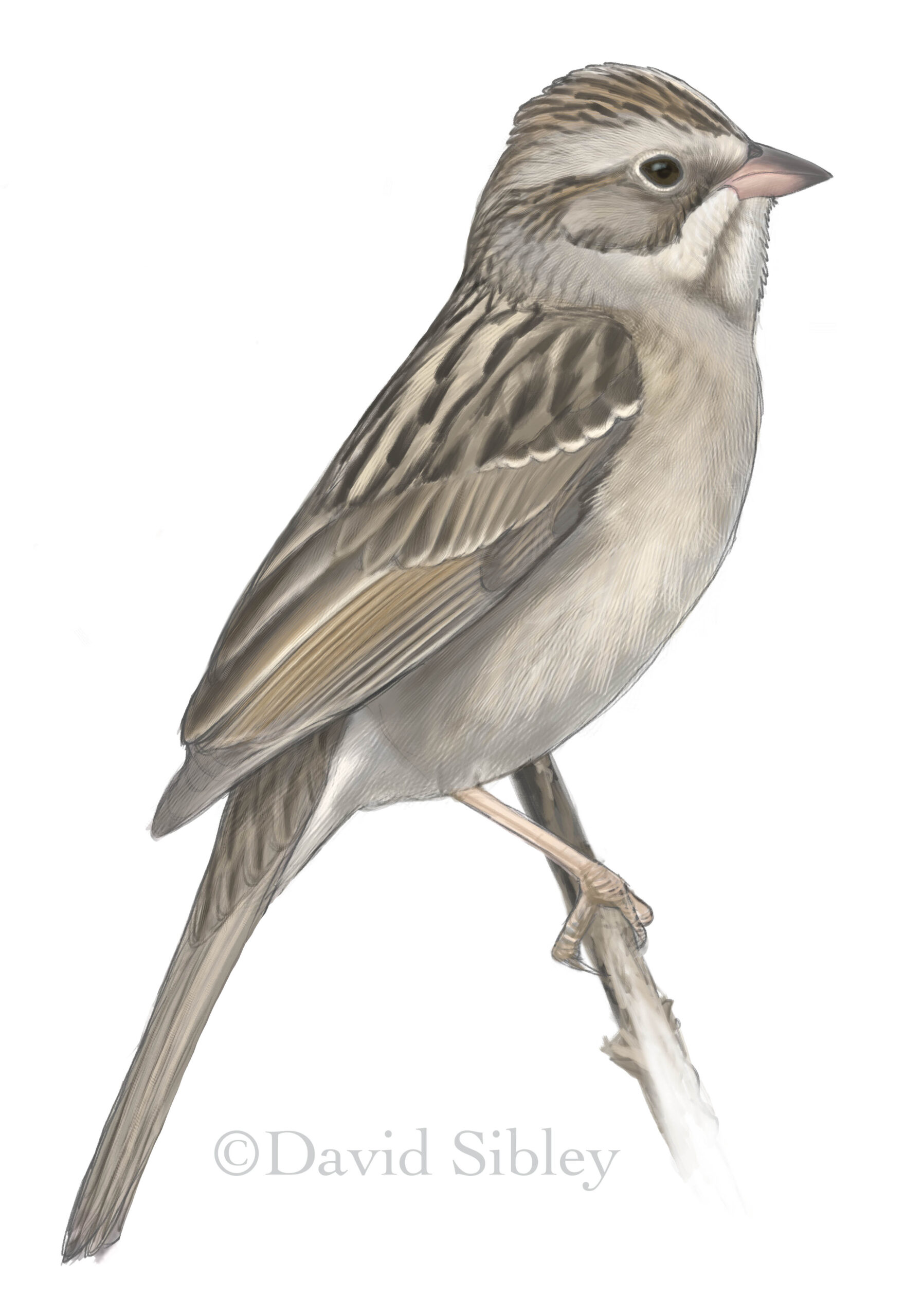
Sagebrush
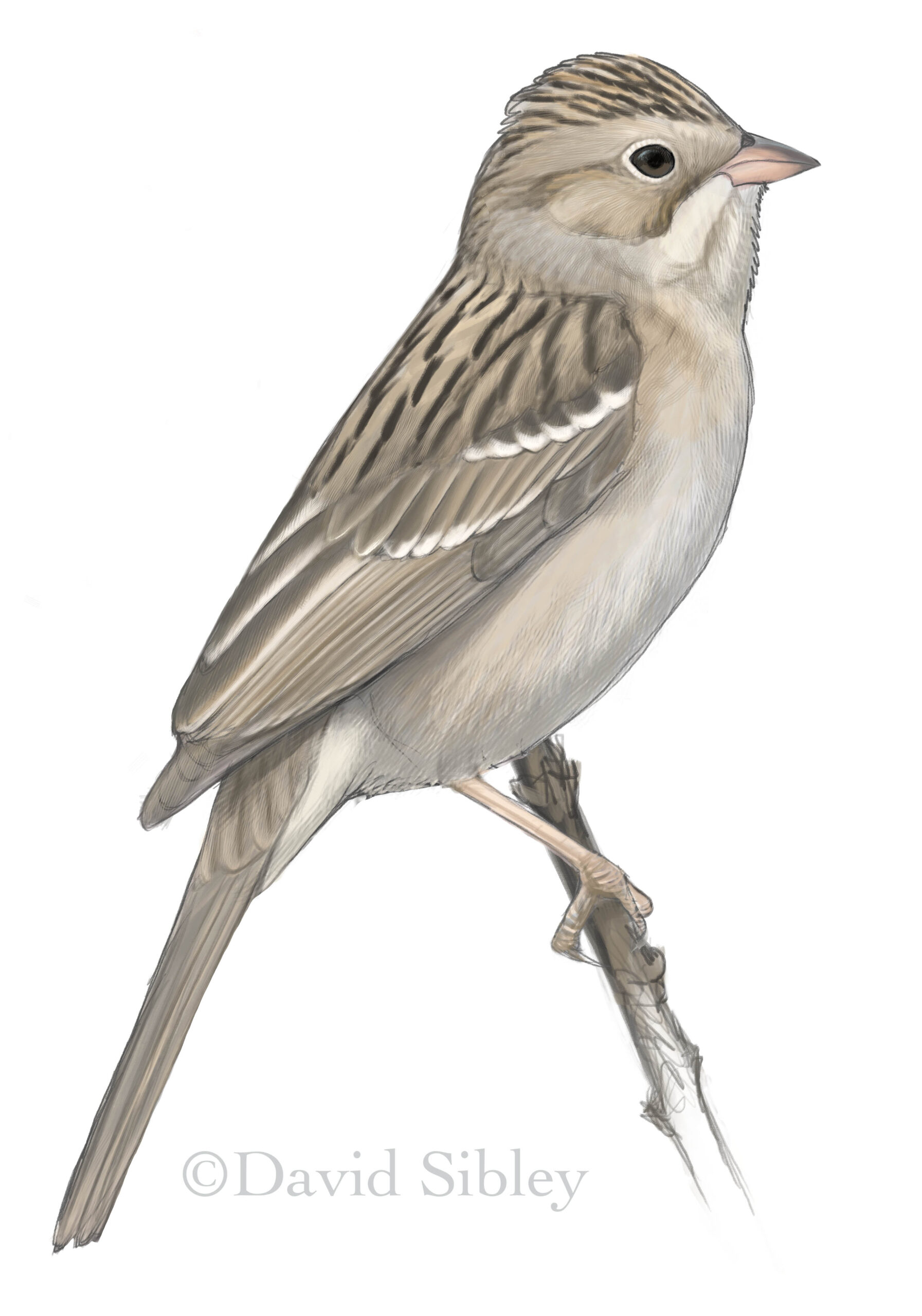
Timberline vs Sagebrush
Below is a full summary of field marks based on study of museum specimens, photos, field observations and discussions with other birders. The bird I saw in Billings showed almost all of these features, and was the starting point for my study, but I have tried not to assume that it was a typical Timberline Sparrow, and all features have been corroborated by other sources.
Caution: With these two subspecies it’s common to see birds that are ambiguous or misleading. Identification requires extended study and (ideally) direct comparison. Differences between the subspecies are subtle and involve mainly color and contrast, which are often distorted in photos or by lighting and distance in the field.
When comparing the two subspecies, look for these things on Timberline. Features that I find slightly more useful are in bold:
- overall more grayish and more strongly patterned, without significant buff tones on flanks or face
- dark lower border of the dark cheek (moustachial stripe) is more prominent and extends farther back to the lower auriculars, so cheek is almost completely surrounded by dark streaks
- cheeks slightly darker overall, and contrasting slightly with paler eyebrow
- white eyering above eye contrasts more with gray eyebrow
- dark eye line is more prominent, composed of thin blackish streaks, and expanding into a triangle of dark streaks at the rear
- dark lateral throat stripe is more prominent and often connects to complete band across lower throat
- breast averages slightly darker and grayer, contrasting more with whitish throat
- pale median crown stripe is fairly distinct
- sides of neck are darker grayish, distinctly streaked and mottled
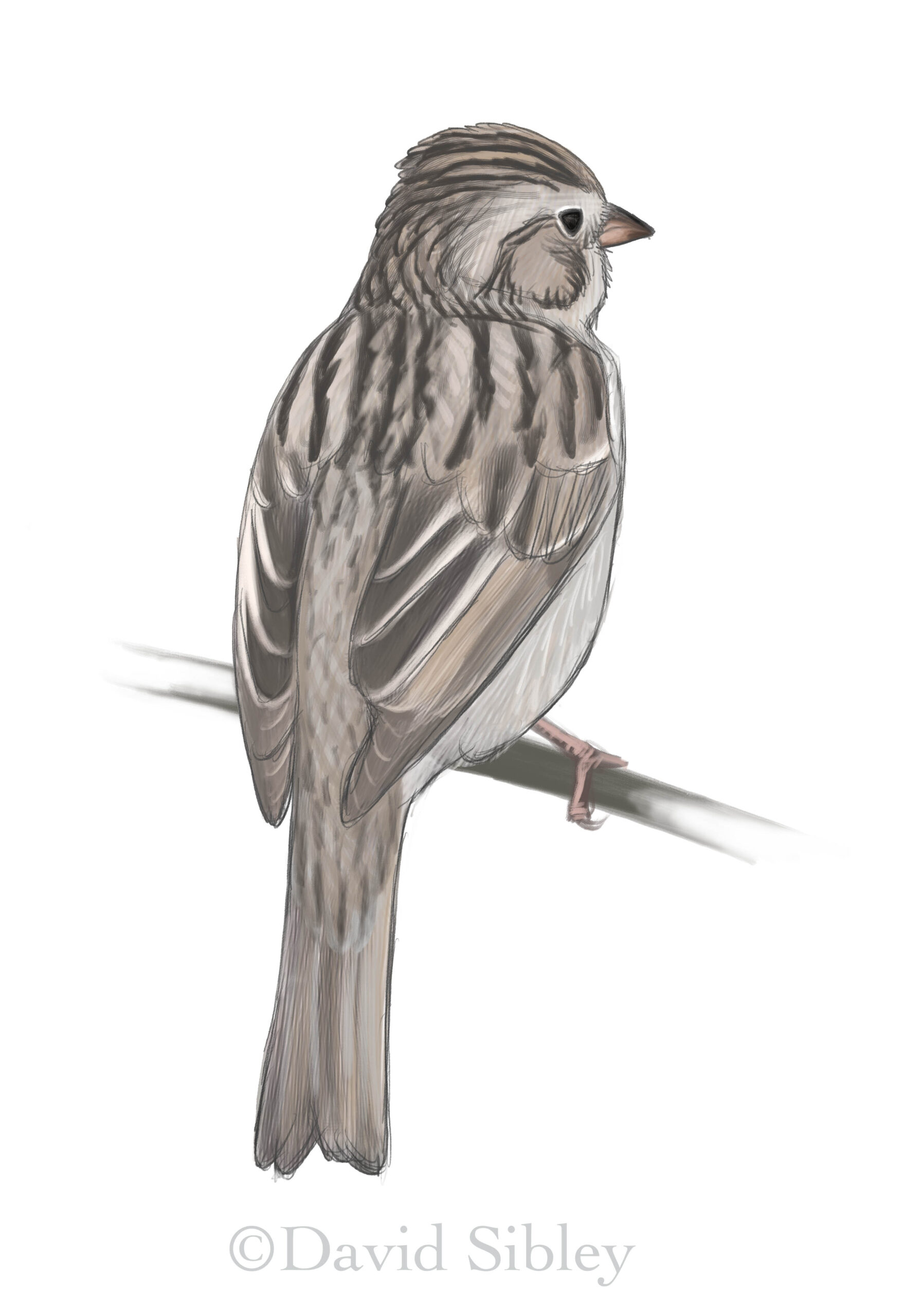
- streaks on back are broader, especially on scapulars, and tend to be more triangular forming a more jagged pattern
- dark streaks on back extend to rump and uppertail coverts, often prominent dark shaft streaks on uppertail coverts
- dark streaks on center of back coalesce into one nearly solid dark central stripe, and ground color next to this paler, forming a subtle “suspenders” pattern like Clay-colored Sparrow
- wing bars average less obvious, narrower and drabber
- wing edges darker and more rufous-tinged
- bill slightly larger, longer, darker, may appear thinner
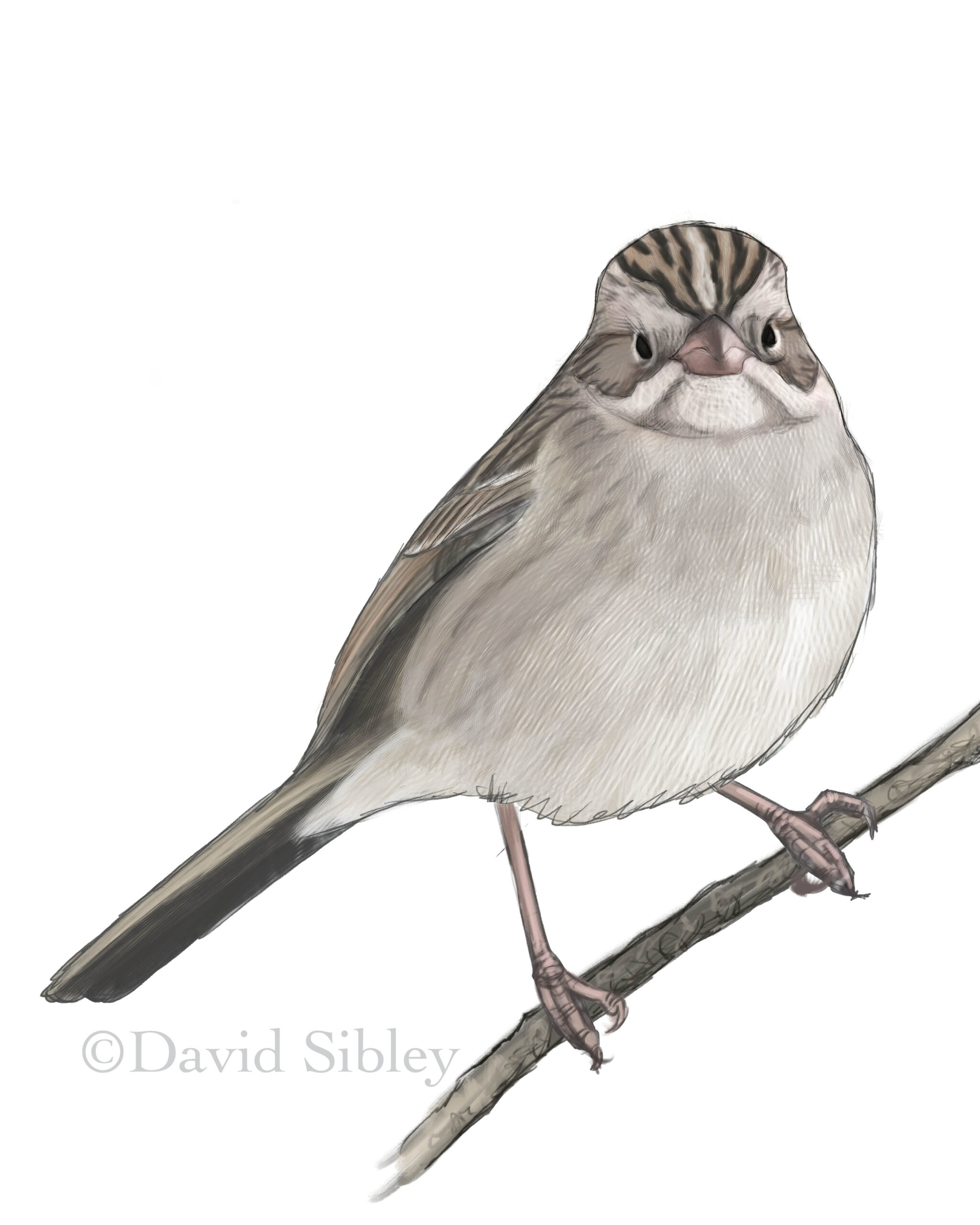
Brewer’s Sparrows viewed from the front
Timberline
Sagebrush
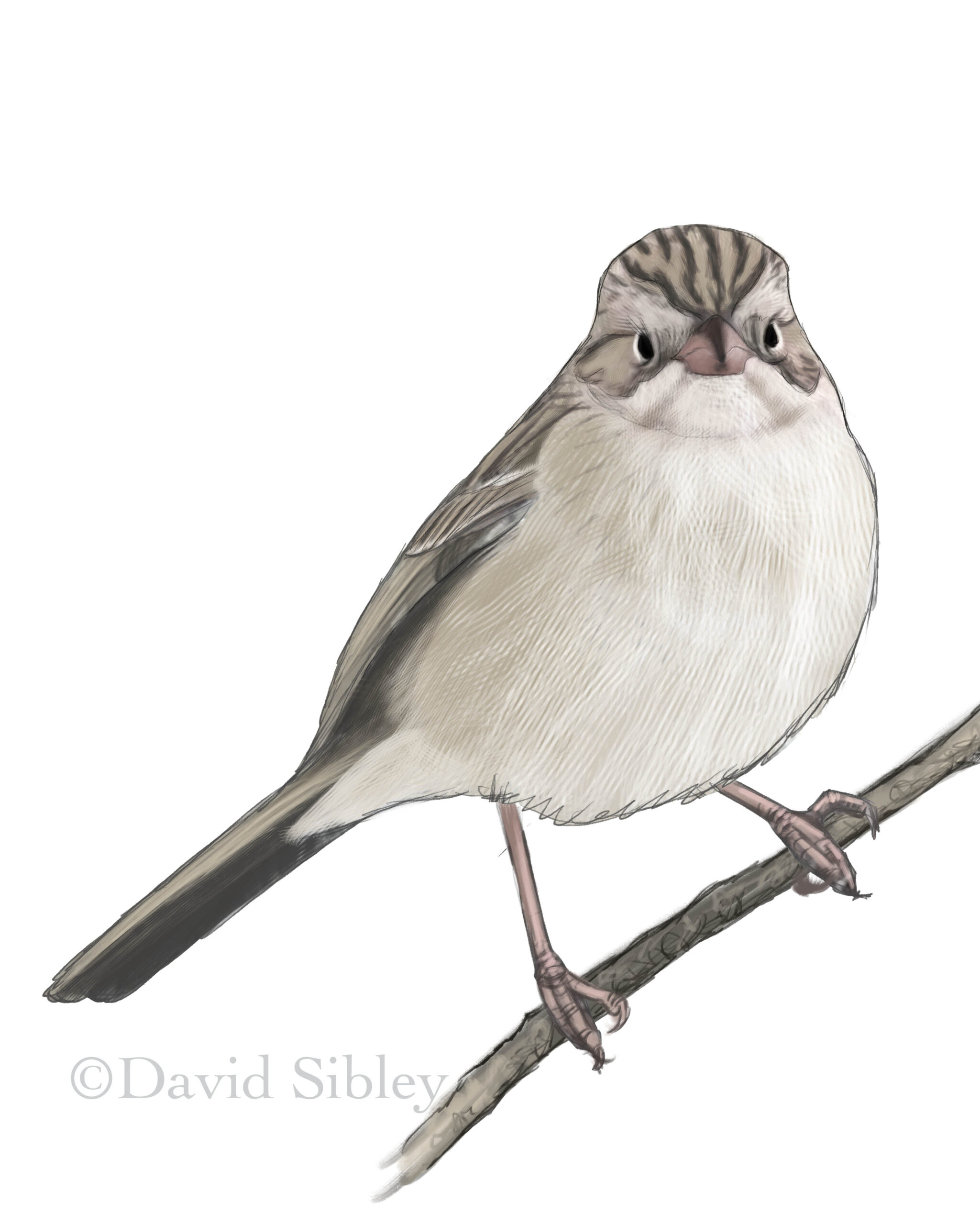
When looking for Timberline in a head-on view notice the pale central crown stripe, as well as the dark lateral throat stripes. The impression of a more striped head (with dark cheeks) and gray breast contrasting with pale throat can also be apparent.
Brewer’s Sparrows viewed from the behind
Timberline
Sagebrush
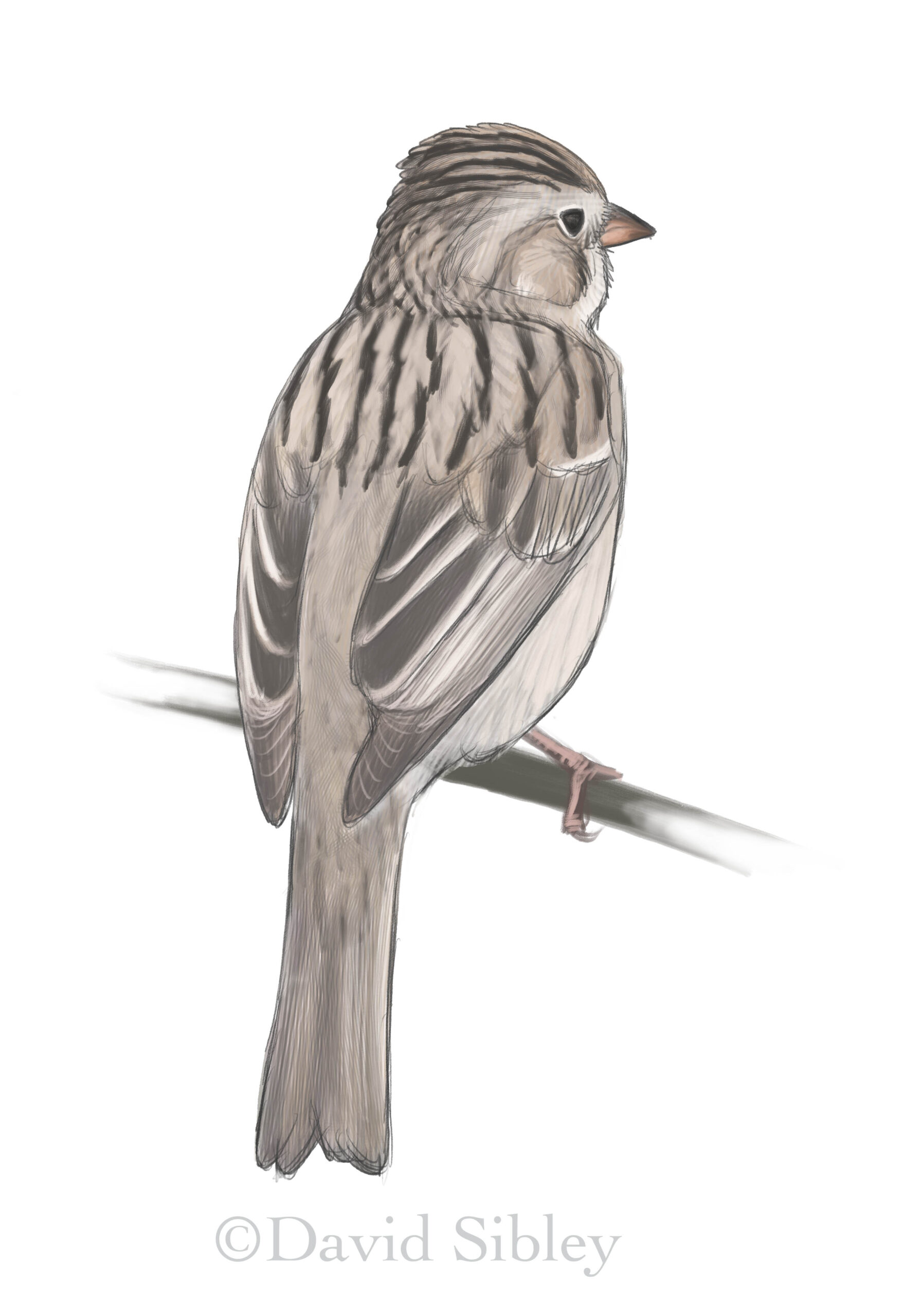
In this view patterns of streaking on the back, rump, and uppertail coverts are more easily seen. Timberline has slightly thicker dark streaks, and these cluster into a central back stripe with paler “suspenders” on either side. Timberline also has more dark streaking or mottling on the rump, and more obvious dark streaks on the uppertail coverts. Darker wings and more heavily streaked nape might also be apparent.
A note about seasonal changes
This whole discussion is about birds in spring and summer. The nonbreeding (fall and winter) appearance of Timberline Sparrow is still very poorly known, with almost no verifiable records at that season. Some of the features described here could be useful in fall and winter, but both subspecies are more colorful then, with pale buff or rufous feather edges obscuring some of the dark patterns.
Sources
Thanks to Brett Walker, Andrew Spencer, and Nathan Pieplow for helpful discussions.
Spencer 2014 – Andrew Spencer. 2014. HOW TO IDENTIFY A TIMBERLINE SPARROW. Earbirding website. http://earbirding.com/blog/archives/4764
Swarth and Brooks 1925 – H. S. Swarth, A. Brooks. 1925. The Timberline Sparrow a New Species from Northwestern Canada. Condor 27: 67-69. – https://digitalcommons.usf.edu/condor/vol27/iss2/6/
Walker 2024 – Brett Walker. 2024. Applying Citizen Science Data to Quantify Differences in Song between Controversial Avian Taxa, the Sagebrush and Timberline Subspecies of the Brewer’s Sparrow (Spizella breweri). Western North American Naturalist. 83. 10.3398/064.083.0410.
Walker et al 2024 – Brett Walker, A. A. Yappert, C. L. Brennan, C. M. Bossu, and A. W. Jones. 2024. Field research guided by citizen science and monitoring data reveal a novel alpine breeding distribution and vegetation associations of a declining, habitat-specialist songbird in Colorado, USA. Avian Conservation and Ecology 19 – https://doi.org/10.5751/ACE-02595-190110