

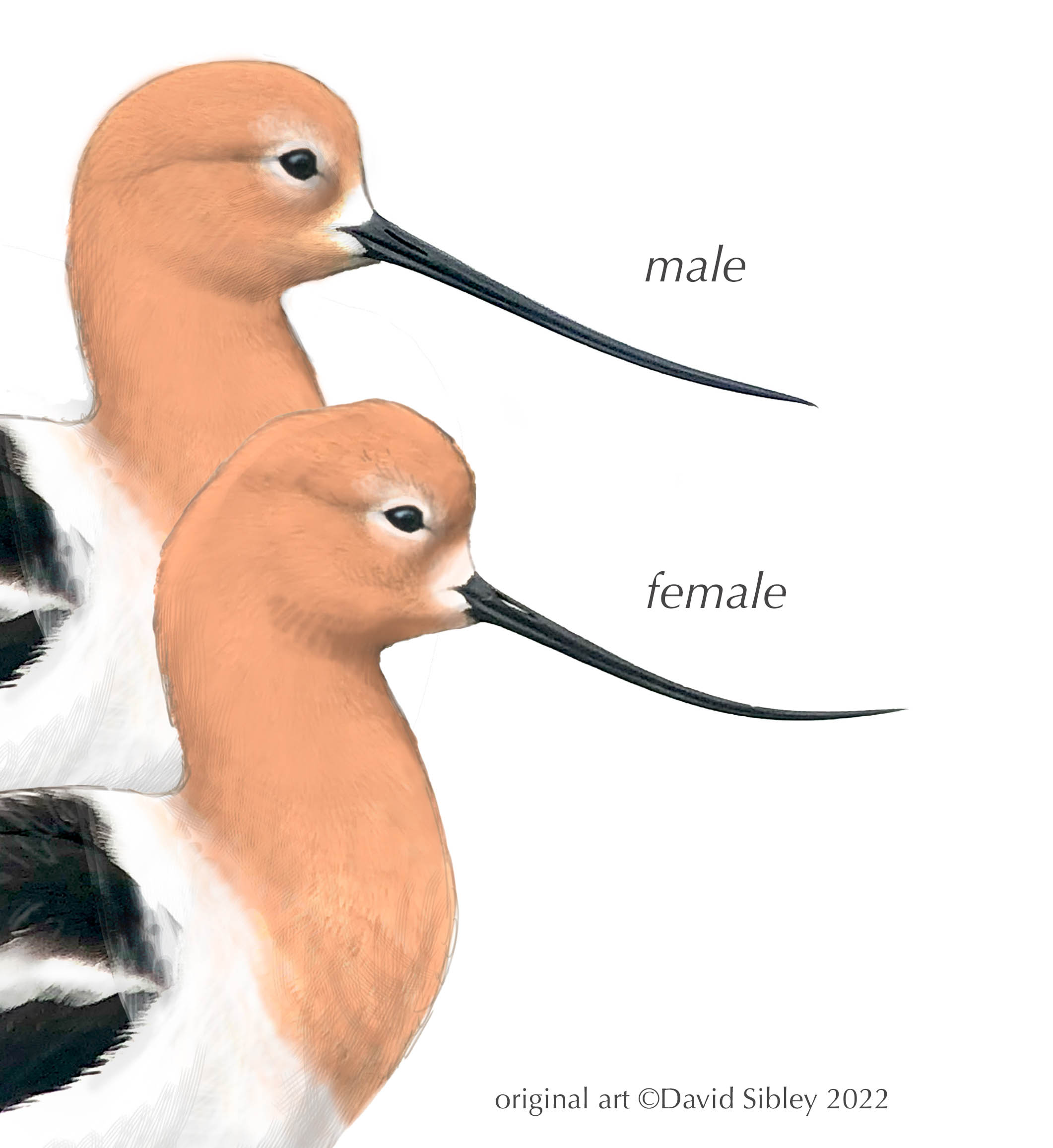
Looking at the different bill shapes of male and female American Avocet reveals other differences.
An earlier version of this essay was published in *Birdwatching* magazine in 2022
I often say that I learn new things every time I go birding, and that the opportunities for learning will never end. One of the keys to that is being an “active” observer and asking questions, and for this column I thought it would be worthwhile to describe my approach and a recent experience.
On a recent April day I was happy to see a close flock of resting American Avocets. I took advantage of that and thought “What questions do I have about American Avocet?” The first thing that came to mind was “What’s up with the few gray-headed birds (non-breeding color) among the many with orange heads (breeding color)?” I have wondered about this variation in the past, and with such close views looking at molt and wear in the wing feathers now I could confirm that all of the gray-headed birds were immatures, approaching one year old, and the older birds had orange heads.
Now that I had identified these few birds as immatures I wondered “Does the sexual difference in bill shape apply to these immatures just like adults?” (Females have noticeably more curved bills than males.) A little scanning and comparison confirmed that even immatures at this age show the distinctive differences in bill shape, just like older birds.
While comparing the bill shapes I came up with another question: “Do adult males and females show any differences other than bill shape?” After identifying several males and females by bill shape and then comparing details between them I concluded that there was no significant difference in plumage color, leg color, size, and more.
But there was something about the head…. females seemed to have a more bulbous forehead, males more sloped. This was variable and hard to pin down, and I left it at that. Later that evening I looked at my photos and worked on some drawings. This reinforced my hunch and gave me some ideas of other details to look for on my next encounter.
A return visit the next day was more conclusive – males and females do seem to have different head shapes! The feathers can be raised or lowered, reducing the differences, but I think there is a real difference (a new discovery and an interesting idea to keep testing the next time I see avocets). In the years since I have confirmed these differences multiple times, and continue to refine my understanding.
Admittedly these are all minutiae, but they add to my appreciation of avocets, and give me ideas for other things to study. The process I describe is the path to big discoveries as well. Simply asking questions, looking for patterns, and watching carefully can lead to revelations, even in your own backyard.
Sources
Hamilton 1975 — Robert Bruce Hamilton. 1975. Comparative Behavior of the American Avocet and the Black-necked Stilt (Recurvirostridae). Ornithological Monographs 17: 1-98 https://sora.unm.edu/sites/default/files/journals/om/om017.pdf